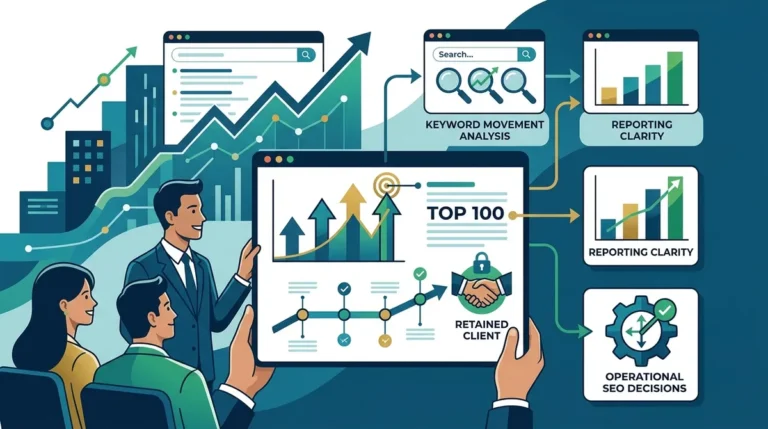

Managing rank tracking for a single site is a matter of hygiene; managing it for fifty clients is a matter of infrastructure. When an agency scales, the primary bottleneck isn't the number of keywords tracked, but the time spent distilling thousands of data points into actionable insights. A professional setup must move beyond simple "up or down" metrics to provide a granular view of Top 100 visibility, SERP feature ownership, and competitive movement across diverse niches.
Organizing Client Portfolios for Scalability
The first failure point in multi-client tracking is a flat account structure. Dumping all keywords into a single bucket creates a data swamp that makes it impossible to isolate performance by industry or service tier. Effective management requires a hierarchical approach that separates data at the root level.
Best for: Agencies managing more than 10 distinct domains or those with multi-regional clients.
Implementing Tagging and Folder Hierarchies
Use folders to group clients by account manager or industry vertical. Within those folders, use tags to categorize keywords by intent (informational vs. transactional), product line, or priority level. This allows you to filter reports instantly. For example, if a core algorithm update hits, tagging allows you to see if the impact was localized to "E-commerce" clients or "Local Service" clients across your entire portfolio.
Multi-User Permissions and Client Access
Operational efficiency improves when clients have restricted, read-only access to their specific dashboards. This reduces the volume of "where do we stand" emails. Ensure your software supports granular permissions so a client only sees their own data, while your internal team maintains a bird’s-eye view of all active accounts.
Mapping the SERP Landscape Beyond Blue Links
Tracking rank position alone is an outdated methodology. Modern SEO requires monitoring the entire SERP real estate, including Local Packs, Featured Snippets, People Also Ask boxes, and Video Carousels. For agencies, this data is the difference between explaining a "drop" in organic position and showing a "gain" in a more prominent SERP feature.
- Share of Voice (SoV): Calculate visibility based on the search volume and the click-through rate of specific positions. This provides a more accurate commercial value than average rank.
- SERP Feature History: Track which features appear for your target keywords and whether your client or a competitor occupies them.
- Mobile vs. Desktop Parity: Monitor the delta between device types. Significant discrepancies often point to technical indexing issues or mobile usability failures.
Warning: High-frequency tracking (daily or on-demand) is essential for clients in volatile niches like finance or news. Weekly updates are insufficient for capturing the "jitter" that precedes major ranking shifts, often leaving agencies reactive rather than proactive during updates.
Automating Movement Analysis and Alerts
You cannot manually check every keyword for every client every morning. Automation must do the heavy lifting. Set up automated triggers that notify account managers when specific conditions are met, such as a keyword entering or exiting the Top 3, or a 10-position drop for a high-volume head term.
Best for: Identifying "quick wins" where keywords have moved from page two to the bottom of page one, signaling an opportunity for immediate content optimization.
Distinguishing Between Noise and Trends
Rankings fluctuate daily due to personalization and data center updates. Effective multi-client tracking software should offer a "Volatility Index" or similar metric to help you distinguish between standard daily movement and a genuine trend. If fifty keywords for one client move down while the rest of your portfolio remains stable, the issue is site-specific. If the entire portfolio shifts, you are likely looking at a broader search engine update.
Automating Client Reporting and Data Visualization
Reporting is often the most time-consuming non-billable task for an agency. To remain profitable, you must automate the delivery of data while maintaining a high level of professional branding. Static PDFs are increasingly being replaced by dynamic, white-labeled dashboards that update in real-time.
Integrate your rank tracking data with other sources via API or connectors for Google Looker Studio. This allows you to overlay ranking shifts with Google Search Console clicks and Google Analytics conversions. Showing a client that a move from position 5 to position 2 resulted in a 40% increase in lead volume is far more persuasive than a standalone ranking chart.
Operationalizing Rank Data for Strategy Adjustments
Data is only valuable if it dictates the next move. Use your tracking software to identify "Keyword Cannibalization" where two pages from the same client are competing for the same term. This is a common issue as clients grow their content libraries. Detecting this early allows you to implement redirects or adjust internal linking before search engines devalue both pages.
Furthermore, monitor "Competitor Discovery" features. Many platforms will automatically identify new domains entering the Top 100 for your tracked keywords. This alerts you to new market entrants or established competitors who have recently pivoted their SEO strategy into your client's space.
Implementing a High-Volume Tracking Workflow
To successfully manage hundreds of clients, your workflow must be repeatable and documented. Start by standardizing your keyword research and onboarding process. Ensure every new client has a "Core" keyword list (high intent) and a "Research" keyword list (long-tail/top-of-funnel).
Audit your tracking lists quarterly. Keywords that have zero search volume or no longer align with the client’s business goals should be purged to keep data clean and costs manageable. Focus your tracking budget on the terms that drive the highest commercial intent and visibility. By treating rank tracking as a structured data operation rather than a set-it-and-forget-it task, you provide the transparency and insights necessary to retain high-value clients over the long term.
Frequently Asked Questions
How often should I refresh rankings for my clients?
For most clients, daily updates are the industry standard. This provides enough data points to see trends without the excessive noise of hourly tracking. However, for high-stakes launches or during known algorithm updates, on-demand refreshes are necessary to provide immediate feedback on site changes.
Should I track keywords globally or locally?
If your client has a physical footprint or serves specific geographic regions, local tracking is mandatory. Rankings can vary significantly between cities or even zip codes. For purely digital or national brands, global or country-level tracking is usually sufficient unless you are monitoring localized SERP features like the Map Pack.
How do I handle clients with thousands of keywords?
Focus on "Representative Tracking." You don't necessarily need to track every long-tail variation. Track the primary head terms and a statistically significant sample of long-tail keywords. Use tags to group these so you can report on category-level performance rather than getting bogged down in individual keyword fluctuations.
What is the most important metric to show a client?
While clients love seeing #1 rankings, "Share of Voice" or "Visibility Index" is often the most important metric. It demonstrates the client's overall dominance in their niche and accounts for search volume, making it a better proxy for potential traffic and revenue than an average position score.