
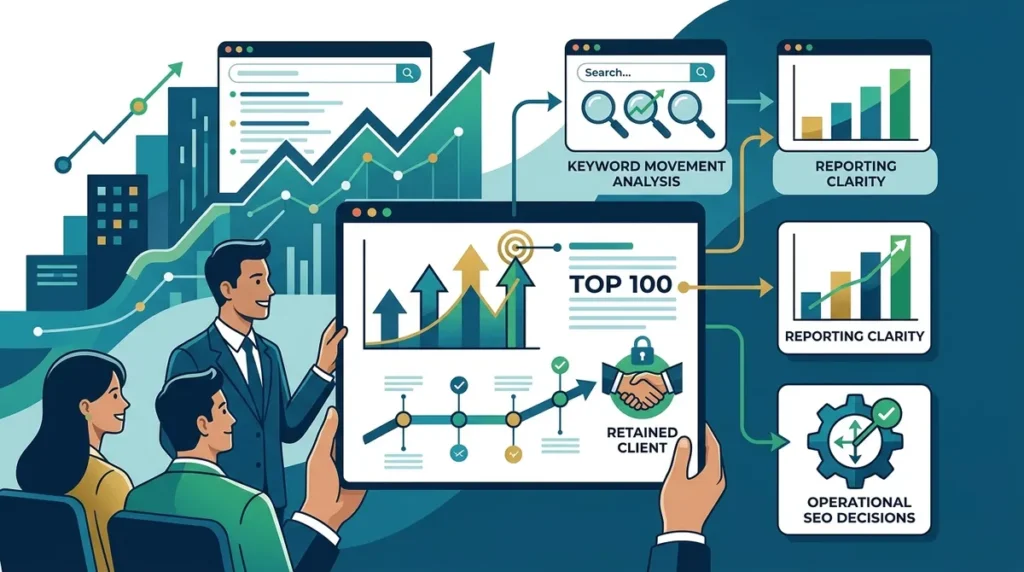
Client retention in SEO is rarely about the absolute position of a single keyword. It is about the narrative of progress and the mitigation of perceived risk. When a client asks, "What are we paying for?" they are usually signaling a disconnect between the technical work performed and their visibility into market movement. Rank tracking, when used as a retention engine rather than a mere reporting checkbox, bridges this gap by providing granular evidence of competitive displacement and incremental wins that standard analytics might miss.
Mapping Keyword Clusters to Business Value
Generic rank tracking reports often fail because they treat every keyword with equal weight. To retain a client, you must align your tracking data with their specific revenue drivers. This requires segmenting keywords into clusters—such as "High Intent," "Brand Protection," and "Top of Funnel"—to demonstrate how SEO efforts are fueling different stages of the sales cycle.
Best for: Agencies managing complex B2B accounts where lead quality varies significantly by search intent.
By isolating "High Intent" clusters, you can show that while overall traffic might be flat, the rankings for terms that actually convert are improving. This level of detail prevents clients from making emotional decisions based on surface-level data. Use tagging features within your software to categorize keywords by product line or service area, allowing you to report on "Share of Voice" within specific niches rather than the entire web.
Using Share of Voice to Neutralize Competitor Anxiety
Clients are often hyper-reactive to a single competitor outranking them for a specific term. You can neutralize this anxiety by shifting the conversation toward Share of Voice (SoV). SoV provides a weighted percentage of the total available click-through rate for a set of keywords, offering a more stable and realistic view of market dominance.
- Identify Displacement: Show the client exactly which competitor lost ground when your rankings improved.
- Market Trend Analysis: Demonstrate if a ranking dip is a site-specific issue or a broader industry trend affecting all players.
- Visualizing Dominance: Use SoV charts to show that despite minor fluctuations, the client’s overall footprint in the Top 10 is expanding.
When a client sees that they own 35% of the "Share of Voice" compared to their nearest rival's 12%, a temporary drop from position 2 to position 4 on a single high-volume term becomes a minor data point rather than a reason to cancel the contract.
The Early Warning System: Monitoring Top 100 Movement
Retention is often won or lost in the "striking distance" zone. If you only report on keywords already on page one, you are missing the opportunity to show the "work in progress" that justifies your monthly retainer. Tracking movement within the Top 100 allows you to identify positive momentum long before it results in a conversion.
Pro Tip: Set up automated alerts for keywords moving from page three to page two. This "striking distance" report is your most effective tool for mid-month check-ins, proving that your optimizations are gaining traction with search engine algorithms before the final results are visible in Google Search Console.
Conversely, monitoring the bottom of the Top 100 serves as an early warning system. A sudden disappearance of long-tail terms often precedes a larger algorithmic adjustment or a technical crawl error. Catching these issues and presenting them to the client with a proactive fix—rather than waiting for them to find the error—builds the trust necessary for long-term retention.
Translating Volatility into Operational Decisions
SEO is inherently volatile, and clients who do not understand this are the most likely to churn. Use rank tracking software to visualize SERP volatility over time. When a major update occurs, showing the client a volatility index alongside their specific ranking stability proves the robustness of your strategy.
Best for: Justifying "Maintenance" months where new content production might be lower but technical monitoring and defensive SEO are high.
Movement analysis should be used to explain *why* changes occurred. If a ranking dropped, was it due to a competitor launching a new backlink campaign, or did Google change the SERP layout to favor video carousels? By providing this context, you transition from a "vendor who watches numbers" to a "consultant who interprets the market."
Customizing Reporting Depth for Stakeholder Levels
A common mistake in client reporting is sending the same data to the Marketing Manager and the CMO. To increase retention, your rank tracking data must be formatted for the person reading it. The Marketing Manager needs the granular, keyword-level movement to coordinate with their content team. The CMO needs high-level trend lines and competitive benchmarking.
Use dynamic dashboards that allow for tiered access. The C-suite should see a "Visibility Index" that aggregates performance across thousands of terms into a single, easy-to-digest growth metric. Meanwhile, the operational team should have access to daily updates and landing page-specific performance. This ensures that every stakeholder sees the value of the SEO program through the lens of their own KPIs.
Establishing a Proactive Communication Cadence
Don't wait for the monthly report to share a win. If a high-value keyword hits the #1 spot or a new featured snippet is captured, use your tracking software to trigger a notification and send a quick, manual update. These "micro-wins" create a positive feedback loop and remind the client of your value between formal meetings.
This proactive approach changes the dynamic of the relationship. Instead of the client chasing you for updates, you are consistently feeding them evidence of success. This builds a "bank of goodwill" that protects the relationship when inevitable ranking fluctuations occur.
Building a Defensible SEO Roadmap
To secure a contract renewal, use your rank tracking data to forecast future opportunities. Analyze the keywords where the client is currently ranking in positions 11-20. Quantify the potential traffic increase if those terms move to the Top 3. By showing the client exactly how much "money is left on the table," you make it difficult for them to stop the engagement.
This data-driven forecasting turns your rank tracking tool into a sales tool for your own services. It shifts the focus from what has been done to what is still possible, framing the ongoing relationship as an investment in future growth rather than a recurring expense.
Frequently Asked Questions
How often should I share rank tracking data with clients?
While you should monitor data daily, sharing it daily can lead to over-analysis of minor fluctuations. Monthly formal reports supplemented by "micro-win" alerts for significant milestones provide the best balance of transparency and strategic focus.
What is the most important metric for client retention?
Share of Voice (SoV) is typically the most effective retention metric. It provides a macro view of market share that is less susceptible to the "noise" of individual keyword volatility, making it easier for executives to understand the overall health of the SEO program.
Should I show clients keywords that are dropping in rank?
Yes. Transparency is critical for long-term trust. Presenting a ranking drop alongside an analysis of *why* it happened and a clear plan to address it demonstrates expertise and prevents the client from feeling like you are hiding bad news.
How do I handle a client who only cares about one specific keyword?
Use rank tracking to show the "halo effect." Demonstrate how your work on that specific term has also improved rankings for dozens of related long-tail keywords, increasing total traffic even if the primary term remains stubborn. This broadens their perspective on what success looks like.