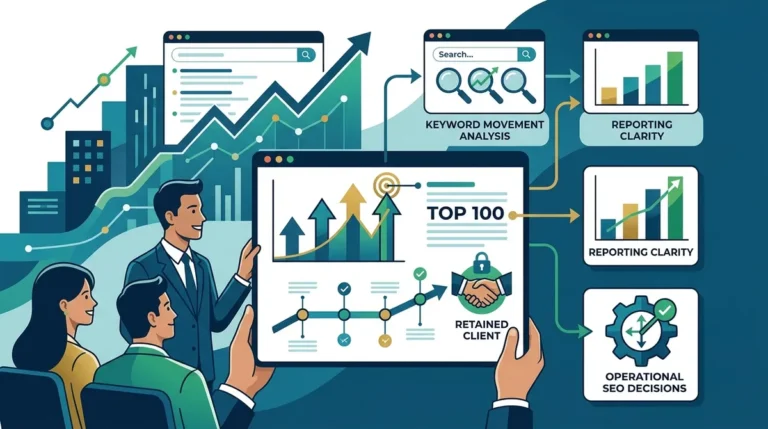

For an SEO agency, rank tracking is not a vanity exercise; it is the primary telemetry for client retention. When a client asks why organic traffic dipped on a Tuesday, an agency relying on weekly updates or cached data from three days ago is already behind the curve. The difference between a standard tool and a high-performance rank tracker lies in the refresh rate, the depth of the SERP analysis, and the ability to segment data into actionable insights that prove ROI.
Most entry-level tools provide a surface-level view of the top 10 or 20 positions. For agencies managing enterprise accounts or high-velocity e-commerce sites, this is insufficient. You need to see the movement across the top 100 results to identify emerging competitors and "striking distance" keywords before they ever hit the first page. If your software isn't providing daily updates or on-demand refreshes, you are managing your clients' reputations with a blindfold on.
The High Cost of Reporting Latency
In the wake of a Google Core Update, the first 48 hours are critical. Clients monitor their own high-volume terms and will notice fluctuations before your scheduled weekly report arrives. If your software lacks the infrastructure to provide daily, automated refreshes, your account managers spend their time apologizing rather than strategizing.
Best for: Agencies managing clients in volatile niches like YMYL (Your Money, Your Life), news, or high-competition retail.
High-performance tracking allows you to correlate specific site changes—such as a new batch of backlinks or a technical site migration—directly with ranking shifts. Without daily data points, the "noise" of the SERPs makes it impossible to isolate which lever actually moved the needle. Agencies need software that treats data as a live stream, not a static snapshot.
Granularity Beyond the Top 10
While the first page of Google captures the majority of clicks, an agency's real work often happens on pages two through ten. Tracking the top 100 results is essential for identifying "striking distance" opportunities—keywords ranking in positions 11-20 that require only a minor optimization push to move into high-traffic territory.
Identifying Emerging Competitors
By monitoring the full top 100, agencies can spot new market entrants before they become a threat. If a new competitor suddenly appears for 50 target keywords in the 80-90 range and climbs to the 40s within a week, that is a signal of an aggressive SEO campaign. Better software allows you to aggregate this "Share of Voice" data, giving your clients a competitive intelligence report that justifies your monthly retainer.
Movement Analysis and Volatility Scores
Raw ranking numbers are often misleading. A keyword might drop from position 3 to 5, but if the entire SERP is in flux due to an algorithm test, that drop is less concerning than a solo slide. Advanced software provides a volatility index or "SERP weather" specific to your tracked keywords. This context prevents knee-jerk reactions to minor fluctuations and helps focus resources on genuine technical issues.
Mapping the Modern SERP Landscape
The "blue link" era is over. Today, a "Position 1" ranking might sit below a four-unit PPC block, a Local Pack, a "People Also Ask" (PAA) section, and an AI-generated overview. If your tracking software only reports a numerical position without identifying SERP features, your reporting is fundamentally inaccurate.
- Local Pack Integration: For multi-location brands, tracking must be localized to the zip code or neighborhood level, not just the city.
- PAA and Featured Snippets: Tracking whether a client owns the snippet or appears in the PAA box is vital for "zero-click" search strategies.
- Visual Search and Video: Identifying when images or YouTube videos occupy prime real estate allows agencies to pivot content production toward those formats.
Warning: Relying on "Average Position" as a primary KPI is a dangerous trap. A site can have a stable average position while losing its highest-converting keywords, masked by improvements in low-volume, long-tail terms. Always segment reporting by keyword clusters and search intent.
Operational Efficiency and Data Portability
Agencies are low-margin businesses that scale through efficiency. Manually exporting CSVs and formatting them into slide decks is a waste of expensive talent. Better rank tracking software prioritizes data portability through robust APIs and native integrations with tools like Looker Studio, Google BigQuery, and Tableau.
Best for: Scaled agencies managing 50+ clients who require custom, white-labeled dashboards.
The software should allow for "tagging" and "folder" structures that mirror your agency’s internal organization. Whether you segment by product category, intent (informational vs. transactional), or priority level, the ability to filter thousands of keywords instantly is the difference between a 10-minute reporting task and a 4-hour manual audit. Furthermore, white-labeling capabilities ensure that the client-facing interface reinforces your agency's brand authority, providing a professional touchpoint that feels like a proprietary solution.
Auditing Your Current Tracking Stack
To determine if your current software is hindering your growth, conduct a brief audit of your last three client reports. If you find yourself manually explaining away "missing" data or unable to show exactly why a ranking dropped during a specific week, your tools are failing you. Transitioning to a high-frequency, high-depth tracker is an investment in client retention. Look for platforms that offer unlimited users—allowing your entire team to access data without seat-based price hikes—and prioritize those that offer historical data imports so you don't lose your year-over-year benchmarks during the switch.
Frequently Asked Questions
How often should an agency refresh rank data?
For active campaigns, daily refreshes are the industry standard. For high-stakes events like product launches or site migrations, the ability to trigger an on-demand refresh is necessary to provide real-time feedback to stakeholders.
Is tracking the top 100 results really necessary?
Yes. Tracking the top 100 allows for "Share of Voice" calculations and competitive gap analysis. It helps agencies identify which keywords are beginning to gain traction long before they reach the first page, allowing for proactive rather than reactive optimization.
What is the most important SERP feature to track?
This depends on the client's industry, but generally, the "Local Pack" for brick-and-mortar businesses and "Featured Snippets" for informational sites are the most critical. Tracking these ensures you understand why organic traffic might be declining even if your numerical "blue link" position remains stable.
How do API costs impact agency profitability?
Many tools charge significant premiums for API access or limit the number of calls. Agencies should look for software with transparent, flat-rate API pricing or generous limits to ensure that scaling their reporting dashboards doesn't eat into their service margins.