
The Monday morning email from a panicked client is a staple of agency life. Usually, it contains a screenshot of a single keyword that dropped from position three to position seven, accompanied by a demand for an immediate explanation. To a client, this looks like a failure of strategy; to an SEO, it looks like a Tuesday. The challenge lies in bridging the gap between raw data and business impact without sounding dismissive or overly technical.
Explaining volatility requires moving the conversation away from individual keyword "rankings" and toward "market share" and "visibility trends." When you frame movement as a function of a dynamic marketplace rather than a static scoreboard, you regain control of the narrative. Effective communication here relies on your ability to distinguish between algorithmic testing, competitor aggression, and technical site health.
Distinguishing Between Micro-Fluctuations and Macro-Trends
Clients often conflate daily "jitter" with long-term decline. To manage this, you must define what constitutes a meaningful change. Micro-fluctuations are the small, daily movements within the Top 10 or Top 20 that occur as Google tests different result combinations or refreshes its cache. These are often temporary and self-correcting.
Macro-trends, conversely, represent sustained movement over 14 to 30 days. If a keyword drops and stays down while the entire cluster follows suit, you are looking at a trend. When explaining this to a client, use a 30-day rolling average to smooth out the daily noise. This prevents knee-jerk reactions to "Google dancing" and focuses the client on the trajectory of the campaign rather than the volatility of the hour.
The Role of Data Center Desync
Sometimes, volatility isn't about the website at all; it is about Google’s infrastructure. Google operates across thousands of data centers. During an update or a major crawl, different data centers may serve different versions of the SERP. A client searching from a mobile device in London might see a different result than your tracking software reporting from a localized IP in New York. Explaining this "desync" helps clients understand why their manual searches don't always match the report.
Utilizing Top 100 Visibility as a Leading Indicator
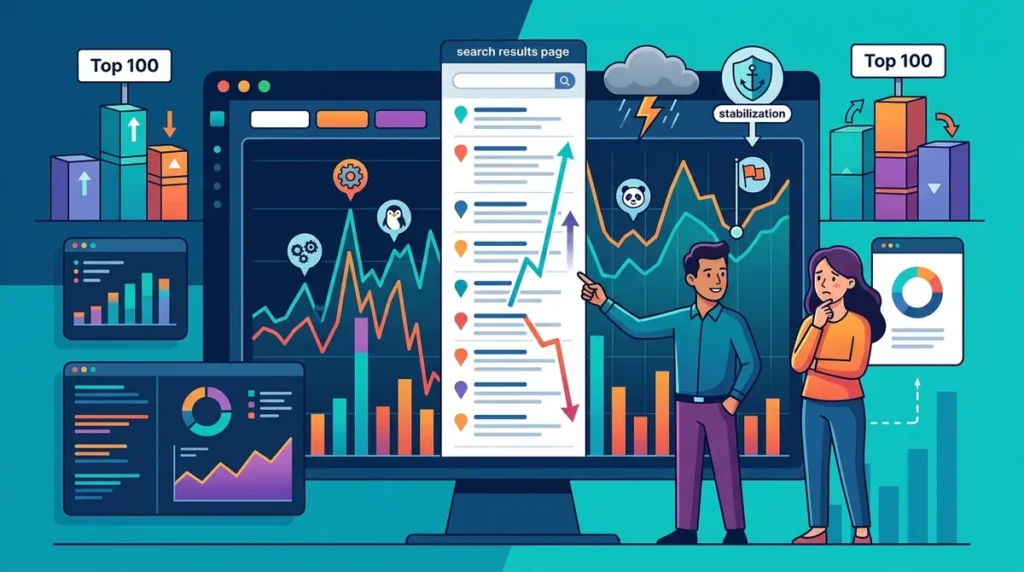
Focusing exclusively on the Top 3 or Top 10 is a strategic error when explaining volatility. If a core set of keywords drops from position 5 to 12, it looks like a loss. However, if your software shows that the total number of keywords ranking in the Top 100 has increased by 15% in the same period, the site is actually gaining "algorithmic trust."
Best for: High-growth accounts where new content is being indexed rapidly. Showing Top 100 movement proves that Google is discovering and categorizing new pages, which is the precursor to Top 10 rankings.
- Visibility Score: A weighted metric that accounts for both rank and search volume. If visibility is stable while specific ranks fluctuate, the "loss" is likely in low-value areas.
- Share of Voice: Comparing your client’s footprint against direct competitors. If everyone in the niche dropped, the volatility is a market-wide shift, not a site-specific penalty.
- Keyword Breadth: The total count of unique URLs appearing in the SERPs. An increase here suggests a healthy site architecture.
Pro Tip: When a major drop occurs, check the "Winner/Loser" report for the entire niche. If the top-ranking sites all lost positions to a new SERP feature—like a "Discussions and Forums" block—the issue is a change in SERP layout, not a loss of relevance.
Attributing Volatility to SERP Feature Displacement
Often, a "drop" in ranking is actually a "displacement" by a SERP feature. Google’s move toward AI Overviews (SGE), People Also Ask (PAA) boxes, and Local Packs means that even if you maintain "Position 1" in organic results, you may have moved 1,500 pixels down the page. Clients need to see the "Pixel Height" or "Fold Visibility" to understand why traffic might be dipping despite stable rankings.
The Impact of AI Overviews and Zero-Click Searches
If a client’s primary informational keywords are now being answered by an AI Overview, the volatility they see in traffic is a structural change in search behavior. In these instances, explain that the goal has shifted from "ranking for the click" to "being the source for the AI." Use your tracking data to show which keywords have been "cannibalized" by these features and pivot the strategy toward long-tail queries that require a deep click-through.
Categorizing the Four Pillars of Ranking Shifts
When providing a formal report on volatility, categorize the movement into one of four buckets. This provides a clear framework for the client to process the information without getting lost in the weeds.
1. Algorithmic Revaluation: Google has changed how it weights specific signals (e.g., emphasizing "Experience" in E-E-A-T). This usually results in site-wide shifts across specific categories of content.
2. Competitor Activity: A competitor has launched a backlink campaign or refreshed their content. This is usually localized to specific keyword clusters where the competitor is gaining ground.
3. Technical Debt: Issues like slow server response times, broken redirects, or canonicalization errors. This is the only form of volatility that requires an immediate "fix" rather than "monitoring."
4. Intent Shift: Google has decided that a keyword previously interpreted as "Informational" is now "Transactional." If your page is a blog post and the SERP is now full of product pages, you will lose rank regardless of content quality.
Standardizing the Volatility Response Protocol
To stop the cycle of reactive reporting, establish a "Volatility Protocol" with your clients. This sets expectations for when you will intervene and when you will simply observe. Define a threshold—for example, a 20% drop in visibility over a 7-day period—that triggers a deep-dive audit. Anything below that threshold is reported in the monthly cadence as standard market movement.
By using precise terminology—mentioning "SERP saturation," "weighted visibility," and "intent misalignment"—you position yourself as a consultant managing a portfolio of assets rather than a technician chasing a number. This builds the trust necessary to stay the course when the SERPs get turbulent.
Frequently Asked Questions
How do I explain a drop in rankings when we haven't changed anything on the site?
Explain that SEO is a relative game. Even if your site remains static, your competitors are likely improving their content, earning new links, or fixing technical issues. Additionally, Google frequently updates its core ranking weights, meaning the "value" of your existing signals may have changed in the eyes of the algorithm.
Why does my rank tracking software show a different position than what I see on my phone?
Personalization and localization are the primary drivers here. Google tailors results based on your search history, physical location, and device type. Professional tracking software uses "clean" browsers and localized IPs to provide an objective, non-personalized view of where the average user finds you.
Should we change our strategy immediately after a major algorithm update?
No. You should wait at least 14 days for the "dust to settle." Google often rolls out updates in stages, and initial volatility can be followed by a recovery as the algorithm refines its data. Making drastic changes during an update makes it impossible to tell which changes worked and which were simply part of the algorithm's natural rebalancing.
How can we rank #1 but still see a decrease in organic traffic?
This is usually due to SERP feature encroachment. If Google adds a massive "People Also Ask" section, a sponsored carousel, or an AI Overview above the organic results, the click-through rate (CTR) for the top organic position will drop significantly. In this case, the ranking is successful, but the SERP real estate has become less valuable.