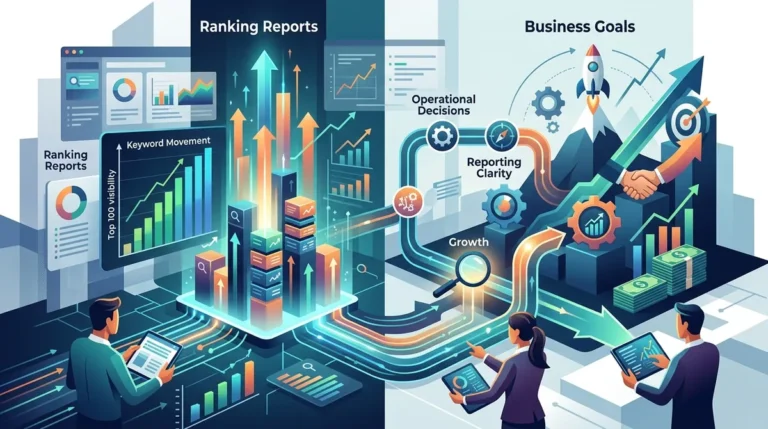

SEO reporting often fails because it prioritizes volume over value. Stakeholders rarely care about a list of 500 keywords moving up three spots; they care about the commercial visibility of specific product categories or the erosion of market share to a new competitor. High-performance rank tracking transforms raw position data into a narrative of business impact. To build better reports, you must move away from static spreadsheets and toward dynamic analysis that highlights movement within the Top 100, SERP feature ownership, and weighted visibility metrics.
Transitioning from Average Position to Share of Voice
Average position is a deceptive metric. A site can maintain an average position of 12 while losing its number one ranking for a high-volume head term and gaining ten rankings at position 40. The "average" stays the same, but the revenue collapses. Effective reporting replaces or supplements average position with Share of Voice (SoV).
SoV calculates visibility by weighting your rank against the search volume of each keyword and the estimated click-through rate (CTR) for that position. This provides a percentage-based score of your total market influence. When reporting to executives, an SoV increase from 12% to 18% in a "High Intent" category is a much more concrete indicator of success than a vague shift in average rankings.
Segmenting Keywords by Intent and Product Category
Reporting on your entire keyword universe in a single block obscures actionable insights. Better reports utilize tagging to segment data into logical clusters. This allows you to isolate performance issues and attribute wins to specific campaigns.
- Brand vs. Non-Brand: Separating these ensures that a surge in brand awareness (from offline ads or PR) doesn't mask a decline in competitive non-brand rankings.
- Funnel Stage: Tag keywords as "Informational," "Investigational," or "Transactional." If your "Transactional" SoV is dropping while "Informational" rises, your content strategy is misaligned with revenue goals.
- Product Lines: For e-commerce, segmenting by category (e.g., "Running Shoes" vs. "Hiking Boots") allows you to report to specific department heads with data relevant to their inventory.
Analyzing Top 100 Movement as a Leading Indicator
Most clients only look at the Top 10, but for an SEO professional, the movement between positions 20 and 100 is the "waiting room" for future revenue. Reporting on this volatility demonstrates that your optimizations are gaining traction before they result in clicks.
Best for: Justifying ongoing retainer costs during the early stages of a technical SEO overhaul or a new content hub launch.
When you show a stakeholder that 50 keywords moved from "Not in Top 100" to "Position 45-60" in a single month, you are proving that Google has indexed and begun to value the new architecture. Use distribution charts that show the count of keywords in buckets: Top 3, Top 10, Top 20, and Top 100. A shift from the bottom buckets to the middle buckets is a measurable win that precedes a spike in traffic.
Pro Tip: Monitor the "Ranking Pages" report to identify keyword cannibalization. If two different URLs are swapping positions for the same keyword every few days, it’s a signal that Google is confused about which page is the authority. Resolve this with canonicals or internal linking before the volatility leads to a permanent drop for both pages.
Visualizing SERP Feature Ownership
Ranking at position one is no longer the ceiling of organic performance. With the prevalence of Featured Snippets, Local Packs, People Also Ask (PAA) boxes, and Image Carousels, a "blue link" report is incomplete. Your reporting must track which SERP features you own and which you have lost to competitors.
If your traffic is dipping despite stable rankings, check your SERP feature coverage. A competitor might have captured a "Featured Snippet" or a "Product Grid" that pushes the first organic result below the fold. High-quality rank tracking software identifies these opportunities. In your reports, include a "SERP Feature Win/Loss" section to show how you are capturing more "pixel real estate" beyond traditional rankings.
Competitor Benchmarking and Movement Analysis
SEO does not happen in a vacuum. Your ranking drops might not be due to your own site’s failures but rather a competitor’s aggressive content push. Modern reports should include a side-by-side visibility comparison against at least three to five direct competitors.
Use movement analysis to identify "rising stars" in the SERPs—competitors who are suddenly gaining ground in your core categories. By reporting on competitor movement, you shift the conversation from "Why did we drop?" to "Here is how the competitive landscape is shifting and how we need to respond."
Automating Data Flow for Operational Clarity
Manual reporting is a waste of high-level talent. To scale an agency or an in-house department, you must automate the data delivery while keeping the insights manual. Use API integrations to pull rank tracking data directly into Looker Studio, Power BI, or Google Sheets.
Automation allows for "always-on" dashboards that stakeholders can check at any time, which reduces the volume of ad-hoc requests. However, the monthly or quarterly report should still feature a human-written executive summary. Use the automated data to find the "why" behind the numbers, focusing on specific technical changes, backlink acquisitions, or algorithm updates that coincided with major shifts.
Refining Your Reporting Workflow
To implement these improvements, start by auditing your current keyword list. Remove "vanity" terms that have no search volume or commercial relevance. Group the remaining keywords into strategic tags and set up automated Share of Voice tracking for each group. Ensure your tracking software is set to a daily refresh frequency; weekly updates are insufficient for catching the immediate impact of Google Core Updates or site migrations. Finally, integrate SERP feature tracking into your primary dashboard so that you can report on total visibility, not just position numbers. This approach ensures your reports are not just data dumps, but strategic documents that drive budget and resource allocation.
Frequently Asked Questions
How often should I refresh rank tracking data for client reports?
Daily refreshes are the industry standard for high-competition niches. They allow you to correlate ranking shifts with specific site changes or algorithm updates. For monthly reporting, daily data provides a more accurate "Average Position" by smoothing out temporary weekend fluctuations.
What is the difference between Share of Voice and Visibility?
While often used interchangeably, "Visibility" usually refers to a simple score based on rank (e.g., position 1 = 100 points, position 10 = 10 points). "Share of Voice" is more precise, as it weights those rankings by the actual search volume of the keywords, giving you a truer sense of your market reach.
Why does my rank tracking software show a different position than my manual search?
Manual searches are influenced by your IP address, search history, and device type. Professional rank trackers use localized, "clean" proxies to simulate a neutral user experience. Always trust the tracked data over a manual search for reporting consistency.
Should I include Top 100 rankings in an executive-level report?
Generally, no. Executives should see Share of Voice, Top 3/Top 10 distributions, and revenue attribution. Save the Top 100 movement analysis for the "Operational" or "Technical" section of the report, intended for the SEO team or marketing managers who need to see leading indicators of growth.